CBDC Reports
Cross-border payments are no longer only a payments problem. They have become an architecture problem, and the distinction matters more than it first appears.
For decades, international money movement was treated as a question of messaging and correspondent relationships. Screening improved. Networks deepened. The progress was real. And yet a treasurer still cannot promise a supplier a settlement time, an exporter still waits, and a household still loses value to fees and delay. The plumbing improved. The architecture did not.
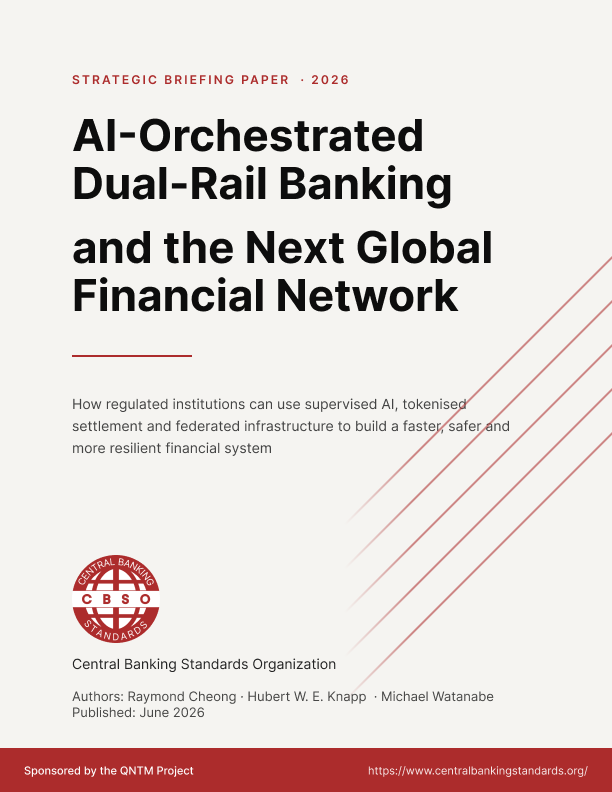
A new strategic briefing paper, published by the Central Banking Standards Organization, makes the case that four developments now treated as separate concerns, namely cross-border payments, digital assets, AI, and operational resilience, are in fact a single shift in the architecture of regulated finance. Institutions that continue to manage them as separate initiatives will find the costs accumulating in places their current frameworks do not measure.
The paper sets out an operating model it terms Dual-Rail Banking. Traditional fiat rails and tokenized settlement rails run side by side, and each transaction becomes a live decision rather than a fixed path. Which rail is fastest. Which is cheapest. Which is compliant in a given corridor, holds sufficient liquidity, produces evidence an auditor will accept, and keeps working when something downstream fails.
No rulebook can hold all of that at once, and no operations floor can evaluate it for every payment in real time. The authors argue that this is the work supervised and auditable AI is suited to, and the reason AI moves from the edge of the institution to the center of its operating model. The emphasis on supervision is deliberate. The proposition is not autonomous finance. It is AI operating inside the institution’s own policy and within the regulator’s line of sight.
The destination is neither Dual-Rail settlement nor AI on its own. It is a federated network of regulated institutions, combining the discipline of licensed banking with the connective logic that the internet brought to information.
Such a network would extend to Tier 2 and Tier 3 banks a reach that today rests with a handful of global players. It would also reduce the system’s overdependence on a small number of dominant banks, networks, and cloud providers, a concentration that has itself become a resilience question. The paper’s central proposition is that the next global financial network will be regulated, AI-orchestrated, Dual-Rail, and federated, and that it will upgrade banks rather than replace them.
This is a category in formation rather than a settled framework, which is why it merits open examination now. The Central Banking Standards Organization publishes this paper to bring that discussion into the open among the institutions, regulators, and researchers concerned with the standards that will eventually govern it.
The full paper is available once you enter your details. CBSO welcomes considered challenge to its arguments, and the standards that follow will be stronger for it.
Institutions and individual researchers working on these questions can find details of CBSO’s membership and how to take part in its standards work here.

© Central Banking Standards Organization (CBSO) – All Rights Reserved.